
Product Sound Quality
The quality of mechanical noise is becoming one of the major factors influencing customer acceptance criteria. Users often derive subjective conclusion about the design and manufacturing qualities from the perceived character of sounds generated by the specific system or product. Therefore the presence of undesirable sound quality character or excessively high noise level will inevitably give the negative impression of an inferior product. The research focus is to understand how annoying and pleasant sounds are being generated and transmitted mechanically, what specific characteristics contained in the noise signatures control psycho-acoustic variables, and how these characteristics relate to design features, material properties and structural dynamic response.
Sound Quality Research Overview
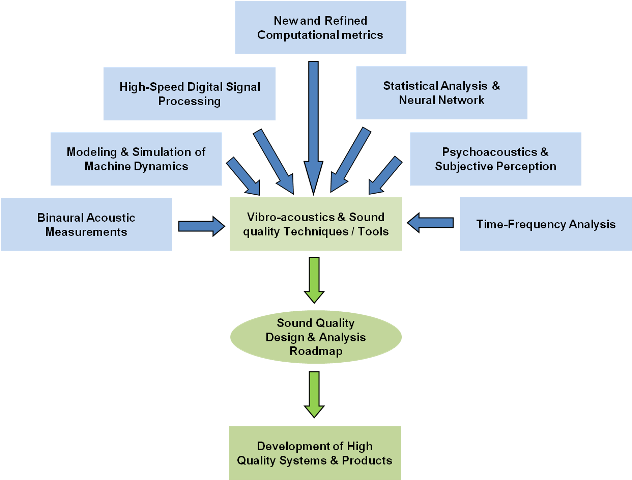
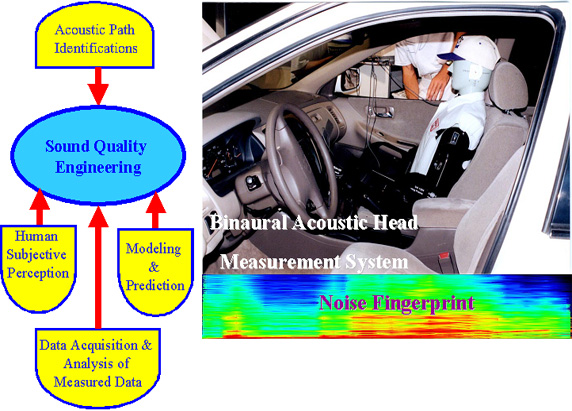
Typical Sound Quality Projects
- Impulsive noise quality analysis using time-frequency feature extraction
- Development of a sound quality model for rotorcraft interior noise .
- An experimental study on automotive door seal noise quality.
- Transmission gear noise quality analysis and simulation.
- Development of in-vehicle gear whine metrics and rating procedures.
- Analysis of automotive transmission planetary gear noise quality.
- Rear axle vibration and noise quality modeling and simulation.
- Analysis and control of engine timing gear noise quality.
- Engine crank rumble noise measurements and perception.
- Engine noise quality perception and identification.
- Exhaust noise studies for design of brand characteristics.
- Tailpipe noise quality simulation and synthesis.
- In-situ tailpipe noise quality identification.
- Experimental characterizations of brake groan and squeal noise.
- Development of quantitative methods to determine electro-mechanical noise quality.
- Impulsive noise quality studies with application to power door locking and closing events.
- Experimental and computational studies of window regulator noise generation and perception.
- Subjective attribute analysis and annoyance factors related to power window systems.
- A study of complex modulated tones on power window noise quality.
- Seat adjuster noise quality evaluation and modeling.
- Analysis of quasi steady-state noise from motor-driven devices.
- Development of efficient computational codes for time-varying noise quality metrics.