
Rolling Element Bearing Matrix Program (REBM)
Introduction
The REBM (Rolling Element Bearing Matrix) program is used to compute the elements of a linearized time-invariant bearing stiffness matrix of dimension 5. The approach is based on the research efforts of Professor Teik C. Lim. Its formulation is derived from the fundamental theory of mechanics and Hertzian theory. The stiffness elements are computed from bearing parameters and static loads or mean bearing displacements.

Various input options
The user will be prompted to choose from one of the four available selections (see figure shown below). For example, Ball Bearing - Input Displacement should be selected if the user wants to input the bearing displacements of the ball bearing, or Ball Bearing - Input Loads should be picked if the user wants to input the static loads of the ball bearing. Alternatively, the user can pick the roller bearing option with either the input displacements or input loads condition.

Plot options
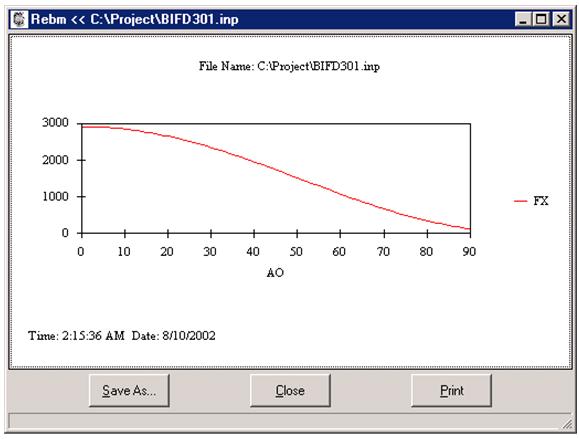
The user can plot loads, displacements and stiffness. An example load plot is given below:
Output
The output of the program are the loaded (1) or unloaded (0) conditions at various angular positions of the rolling element, bearing loads, and elements of the bearing stiffness matrix. A sample output is given below.

For more technical information, please contact Dr. Yawen Wang (yawen.wang@uta.edu).